How to tell if attic mold is from a roof leak
Attic mold from a roof leak leaves a pattern, not a patch. Here is how to read the signs, confirm it with testing, and fix it right in NEWHALL, California.
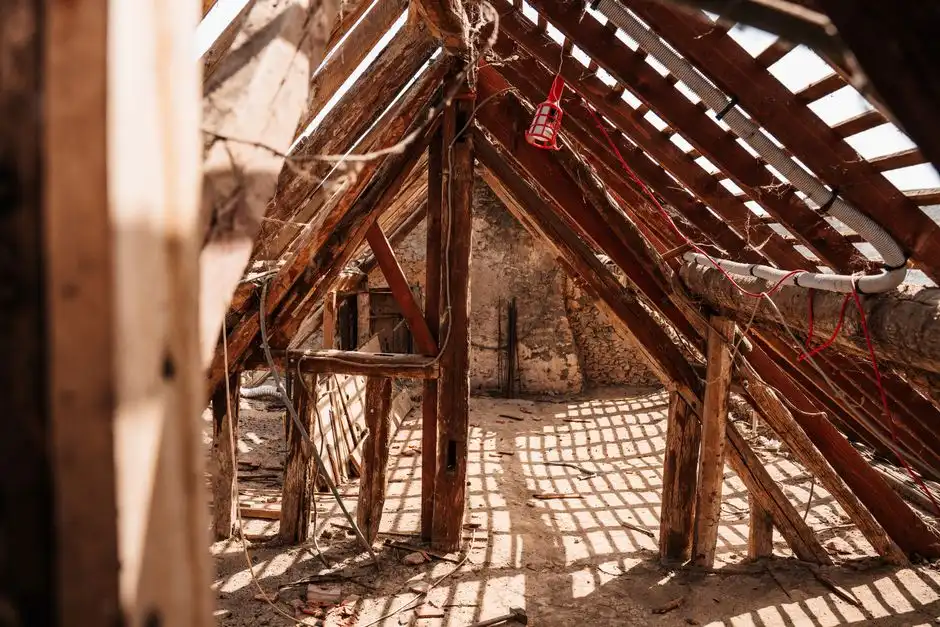
If your attic mold is from a roof leak, the mold will follow a line or a stain rather than cover the whole ceiling evenly, and it will be concentrated under a penetration, valley, or flashing detail. You will usually see dark staining on the roof sheathing, rusted nails, and a musty smell that gets stronger after rain. Condensation mold, by contrast, spreads across the north-facing sheathing and the truss edges first. This post walks through the visual clues, the moisture readings that confirm it, and what removal actually costs in NEWHALL in 2026.
The short answer: roof-leak mold follows water, not humidity
How to tell if attic mold is from a roof leak NEWHALL California comes down to one question: is the mold growing where water lands, or where moisture condenses? Roof-leak mold grows in a trail. It starts at the entry point and spreads downhill along the framing, following the path the water takes. Condensation mold grows in a blanket across the coldest surfaces - usually the north slope sheathing and the metal fasteners.
Attic mold identification in California attics is a moisture-source diagnosis, not a mold-color diagnosis. Black mold near a chimney flashing and black mold on the north sheathing look identical under a flashlight. The pattern and the moisture readings separate them.
If you are not comfortable crawling through insulation in a 110-degree attic, that is normal. A Mold Inspection Near Me in NEWHALL, California gives you a written answer on the source without you having to guess.
How do I know if attic mold is from a roof leak in NEWHALL California?
You know it is a roof leak when three things line up: the mold is concentrated under a roof penetration or flashing, the wood moisture content reads above 20% in that spot, and the stain has a defined edge rather than a soft gradient. Any two of those three is a strong signal.
Here is the sequence our technicians run on every attic call, in order:
- Look up at the roof deck from inside. Water stains on the underside of the sheathing are the first tell. Fresh stains are dark brown; older ones dry to a lighter tan ring.
- Check the nails. Roofing nails that have rusted through in one area - but not the rest of the attic - mean repeated wetting from above.
- Follow the framing. Water runs down rafters and trusses. If the mold is on the top edge of a rafter and trails down its side, that is a leak path.
- Probe the wood. A pin-type moisture meter pushed into the sheathing should read under 15% in a dry attic. Anything over 20% is active moisture.
- Smell the space. A musty odor that spikes after a rainstorm points to an active roof leak, not a chronic humidity problem.
If your mold is concentrated around a chimney, skylight, plumbing vent boot, or valley, that is a roof leak until proven otherwise. Those four spots cause the majority of the attic mold we see in this area.
Roof-leak mold vs. condensation mold: the differences that matter
Roof leak mold NEWHALL California homeowners deal with almost always shows up in one or two spots. Condensation mold shows up everywhere the attic is cold and still.
Where each one grows
- Roof leak mold: under flashing, around penetrations, along a rafter run, on the top of the ceiling joists below the leak.
- Condensation mold: the entire north-facing roof deck, the underside of the sheathing near the ridge, the metal gusset plates on trusses, and the tops of insulation baffles.
What the moisture readings look like
A roof leak gives you a moisture spike in a small area - often 25% to 40% on the sheathing right at the leak, dropping to 10% to 12% two feet away. Condensation gives you a broad, even reading of 16% to 22% across a large section of the deck, with no single hot spot.
Timing
Roof-leak mold gets worse after every rain. Condensation mold gets worse in the winter months when attic surfaces are cold and indoor humidity is high. If you are looking at this in November, you are entering the season where both problems show up - rain events plus cold nights.
Why NEWHALL attics are prone to roof-leak mold
NEWHALL sits in a Santa Clarita Valley microclimate where summer attic temperatures push past 140°F and winter nights drop into the 30s. That swing is hard on roofing materials. Asphalt shingles, flashing sealant, and pipe boots expand and contract daily, and after 15 to 20 years they crack.
Most of the housing stock here was built between the 1960s and the 1990s. That means original pipe boots, original chimney flashing, and in some cases original underlayment. When the first big rain of the season hits - usually late November or December - those aged details leak.
We see this pattern constantly in the older tracts around Attic Mold Testing And Removal in NEWHALL, California, where 1970s and 1980s roofs are hitting the end of their service life at the same time. The homeowners who catch it early spend a fraction of what the ones who wait a full rainy season spend.
Two other local factors matter. First, the Santa Ana wind events strip granules off shingles and lift flashing edges. Second, the dry summer means the wood in your attic is bone-dry by October - so the first leak soaks into thirsty wood and spreads fast.
How to confirm it with attic mold testing in NEWHALL
Attic mold testing NEWHALL is how you move from "I think it is a roof leak" to "I know it is a roof leak, and here is the proof." A visual inspection narrows it down. Testing confirms it.
There are three tests that matter for this question:
- Moisture mapping. Pin and pinless meters across the sheathing, rafters, and insulation. This is what tells you whether the source is active.
- Surface sampling. A tape lift or swab of the visible growth confirms it is mold and identifies the genus. This matters because some genera point strongly to chronic condensation and others to intermittent wetting.
- Air sampling. Spore trap samples inside the attic and outside give you a comparison. Elevated spore counts inside with a matching outdoor baseline can point to an active source.
For a leak-specific diagnosis, we usually pair moisture mapping with surface sampling. Air sampling is more useful after remediation, as a clearance check. If you want the full picture, Mold Testing in NEWHALL, California covers all three.
Timing matters. Do not test an attic that has been dry for three months and expect to find active moisture. Test within a week or two of a rain event if you can. If you cannot wait, we can still read the historical pattern from the staining and the wood condition.
What to watch out for
The biggest mistake we see is treating the mold without fixing the roof. Bleach sprays, foggers, and paint-over products will hide the stain for a season. The next rain brings it back, usually worse, because the moisture has been sitting in the wood the whole time.
Other things to avoid:
- Do not assume it is condensation because the attic is humid. A leak and high humidity can exist in the same attic. Fixing one does not fix the other.
- Do not skip the roof inspection. If the source is a failed pipe boot or a lifted flashing, a roofer needs to be on the roof. Mold remediation does not fix the entry point.
- Do not disturb heavy mold growth without containment. Scrubbing dry mold releases spores into the living space. If the growth covers more than about 10 square feet, that is a containment job.
- Do not trust a visual-only quote. Any remediation price that is not based on moisture readings and a measured area is a guess.
- Do not wait for the next rainy season. Mold that is dormant in a dry attic reactivates the moment moisture returns.
One more: if the mold is on structural framing and not just the sheathing, get it assessed before anyone starts scraping. Weakened rafters are a separate problem from the mold itself.
When to call a professional
Call a professional when the mold covers more than 10 square feet, when the growth is on structural framing, when you cannot identify the moisture source, or when anyone in the house has respiratory symptoms that get worse at home.
We handle the full job: locate the moisture source, contain the work area, remove the affected material, treat the framing, and verify with post-remediation testing. Our team at Mold Remediation Service Newhall works attics in this valley every week, and we know which roof details fail first on the housing stock here.
If you want a straight answer on whether your attic mold is from a roof leak, book a Mold Inspection in NEWHALL, California. We will tell you what we find, what it will take to fix, and what it costs - before any work starts.
Frequently Asked Questions
How do I know if attic mold is from a roof leak in NEWHALL California?
Look for mold concentrated under a roof penetration, moisture readings above 20% in that spot, and rusted nails in one area only. If the mold follows a trail downhill from a chimney, vent, or valley, it is a roof leak. Condensation mold spreads evenly across the cold north sheathing instead.
Can a roof leak cause attic mold in NEWHALL California?
Yes. A roof leak can grow visible mold in 24 to 48 hours on wet wood in warm weather, and within 7 to 10 days in cooler months. In NEWHALL, the first significant rain of the season often triggers growth in attics that have been dry all summer.
Who fixes attic mold from roof leaks in NEWHALL California?
Two trades are involved. A licensed roofer repairs the leak at the roof surface. A mold remediation company handles containment, removal, and clearance testing inside the attic. We coordinate with roofers on most jobs so the source is fixed before we remediate.
How much does attic mold removal cost in NEWHALL California?
Typical 2026 pricing in this area runs $1,500 to $3,500 for a small attic job under 100 square feet, and $4,000 to $9,000 for larger or structural remediation. Roof repair is separate, usually $400 to $1,800 depending on the detail. Testing adds $300 to $700.
Can I just spray the attic mold myself?
For a patch under 10 square feet on a non-structural surface, a DIY approach can work if you fix the leak first. Above that, or on framing, containment and HEPA filtration matter. Disturbing larger growth without containment spreads spores into the living space.
Get help with Mold Remediation Service in NEWHALL
If you have found mold in your attic and you are not sure whether it is a roof leak or condensation, we can tell you in one visit. We inspect, test, and give you a written scope with pricing before we start.
Call (833) 929-5837 to schedule your attic inspection with Mold Remediation Service Newhall.